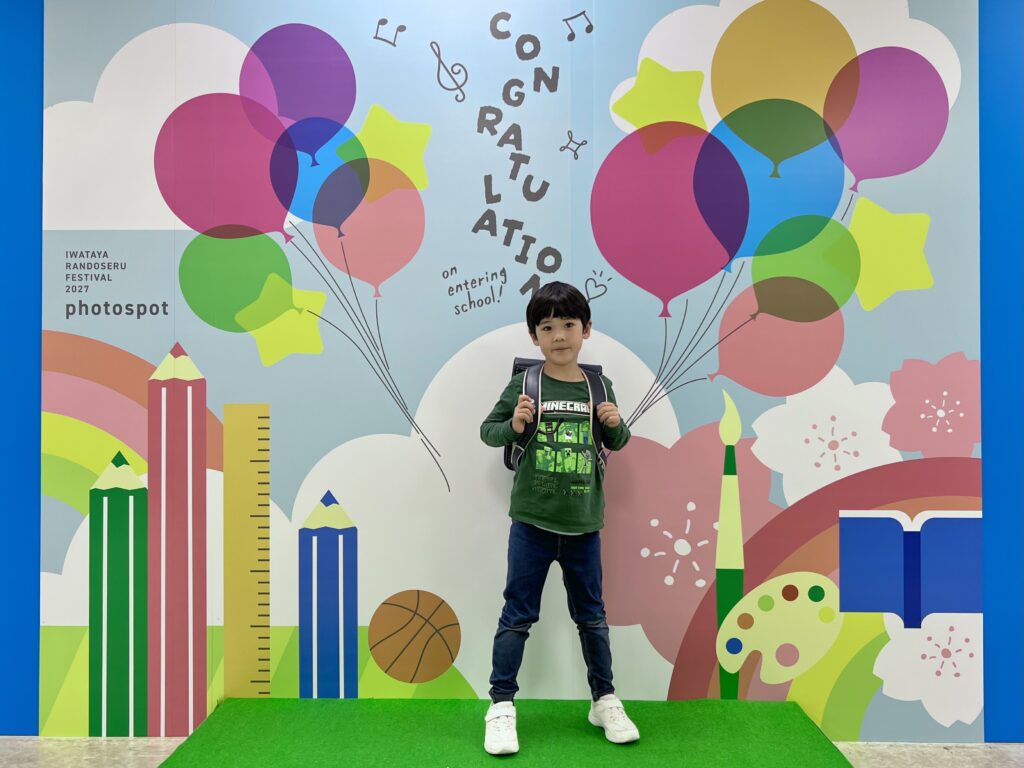
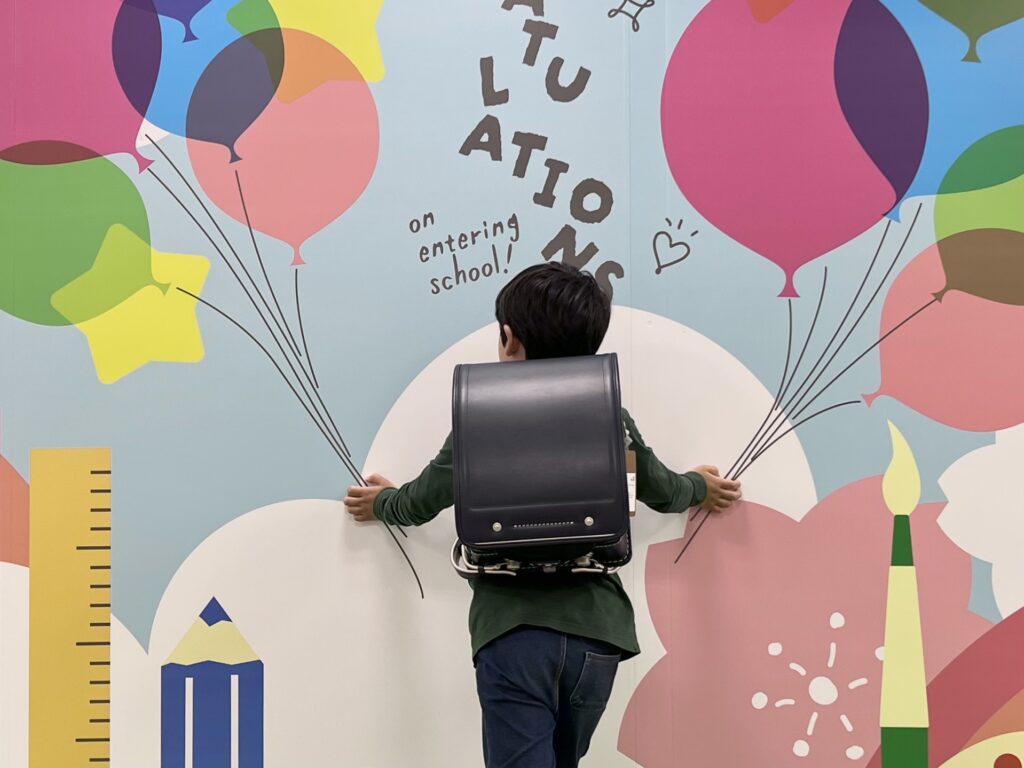
I guess it started last year already – the talk among parents at kindergarten about backpacks for elementary school children. Simply put, during the six years of elementary school, Japanese school children are using a special style of backpack called ランドセル, randoseru, from the imported Dutch word ransel meaning backpack. I have grown up with the Swedish word ränsel, so I was quite familiar with the word but learning about the whole concept has been like suddenly finding myself in the middle of a dense and colorful jungle struggling to try to find my way out of there.
The randoseru has more or less a standard size, is box-shaped with a sturdy body and shoulder belt, has a big lid with a good locking mechanism, and a few loops to hang things from. Back when my wife was a child, there was not much choice, girls had a red randoseru and boys a black one. No options, nothing much to choose between. Nowadays there are so many kinds and colors that I almost faint just thinking of them. There are randoseru made of cow hide, cordovan, synthetic leather, there are colors and color combinations that can satisfy any taste, there are order made options where you can choose the color of each part of the randoseru, can choose the color of the stitches and the shape of the buttons. There are randoseru with focus on being reflective, on being lightweight, there are train themed randoseru, designer branded randoseru, character themed randoseru, different collaborations.
When I understood at the end of last year that the whole buying-a-randoseru was something much more than just going to a store a few months before school start to buy a backpack, I started to research the market and got swooped up in the exciting world of Japanese elementary school randoseru. Talking to other parents I learned that many parents order their randoseru almost a year before school start if not even earlier. Wow, I thought, I need to study up right now, so as the new year began I started to order catalogs from makers I thought seemed interesting, I thought about what aspects to think about when deciding a randoseru, and of course I talked to my son about what he thought – after all it is he who will carry it every day for six years.
For our son, from the start the one and only important point has been the color. Blue. He definitely wants to have a blue randoseru. So I narrowed down my research to focus on blue randoseru. Going through the different makers’ catalogues, instead of felling less confused I started to feel more. There are just too many options, too many makers, too many of everything. Trying to focus on my priorities (like good comfort for carrying the backpack, reflective areas, natural material), helped me discard a few of the makers, but none of the others seemed to offer a randoseru that clearly overlapped with both my son’s and my priorities.
Well, the next natural step was to just go and have a look at different options and so I took my son to visit a randoseru store carrying a few makers to get a first hands-on feeling for this elusive backpack phenomenon. My son of course zoomed in on the most blue of blue randoseru he could find, a version that I was convinced he would get tired of within the first year. I also took the chance to talk to the staff and they told me that many makers, especially the more workshop-style makers, only accepted a certain number of orders every year and that when summer comes there a a lot less options available.
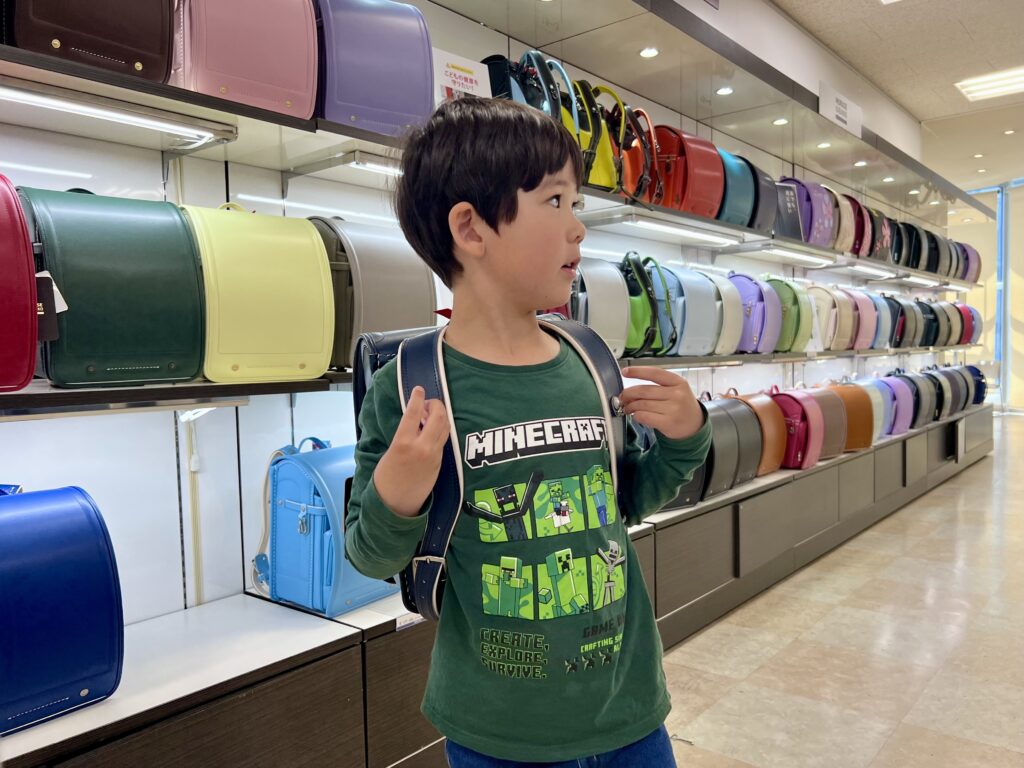
Coming home and looking online, I could see that some versions from the most expensive maker were already sold out, more than a year before school start. And this is another point about the randoseru – they are not cheap and I believe can be seen in many cases as both a fashion statement and a status symbol, maybe not for the children as much as for the parents. I have difficulty believing a six year old cares about if the backpack costs 40.000 yen or 400.000 yen (which seems to be the price range). But the mere idea of buying a randoseru that costs more than many people earn in one month made me realize how big of a deal the randoseru purchase is for many people. Most of the backpacks cost I would say around 60.000 to 80.000 yen and while our family has been talking about finding a properly made backpack that will last six years of rough treatment in the hand of a child, we were not interested in spending our savings on one.
Having gotten a grasp of the basics as well as our priorities and budget, my wife and I set out to go and visit a few stores together to make sure that when we find our son’s (and hopefully our) favorite randoseru it will not be too late to order it. We even ordered a rental randoseru from a manufacturer I had come to like that did not have a store in Fukuoka. It was exquisite, beautiful, smooth, I would have wanted to have that one, but unfortunately it was uncomfortable to carry for our son.
As it happens, the end of April beginning of May, there is a randoseru event at Iwataya department store in Fukuoka where many manufacturers gather in a big event space and so you can see and try many makers at the same time as well as having a chance to talk to the different companies and of course order a randoseru if you want. So last weekend we went there and became overwhelmed when we entered the seventh floor event space. Randoseru everywhere, as far as the eye could see, and I was thinking how in the whole world are we ever going to even know where to begin looking, especially since our son had already seen a blue backpack that he said would be good and now he wanted to play instead.
But giving up is not really in my personality, so I tried to methodically sort away what was not interesting and eventually ended up together with my wife speaking with the president of a smaller workshop style maker while our son was coloring Pokémon images at a nearby table. Strange as it sounds to me (I though I knew about all the manufacturers by now), this was the first time I came in contact with this particular maker and my wife and I both liked the design, the smooth leather, the reflective details, the weather proofing, the price, and there was a even a beautiful dark blue color that our son seemed quite pleased with. During a Mc Donald’s lunch break we discussed what to do, and the option they offered for our son to be able to choose the style of buttons to put on the randoseru was what closed the deal for us. We decided we better go back and order the randoseru since we agreed we would probably not find a better choice no matter how much more we would continue looking. And there was not much time to think as well as it turned out – when writing the order form they staff told us that this model would only be made in a hundred units and the delivery was set for March next year, the month before school start.
Now the randoseru frenzy is over and I feel happy with our choice as well as grateful for the exciting experience of deep-diving into this aspect of Japanese life with a toddler. And I expect I will come back to write about the randoseru when we receive it next year.